
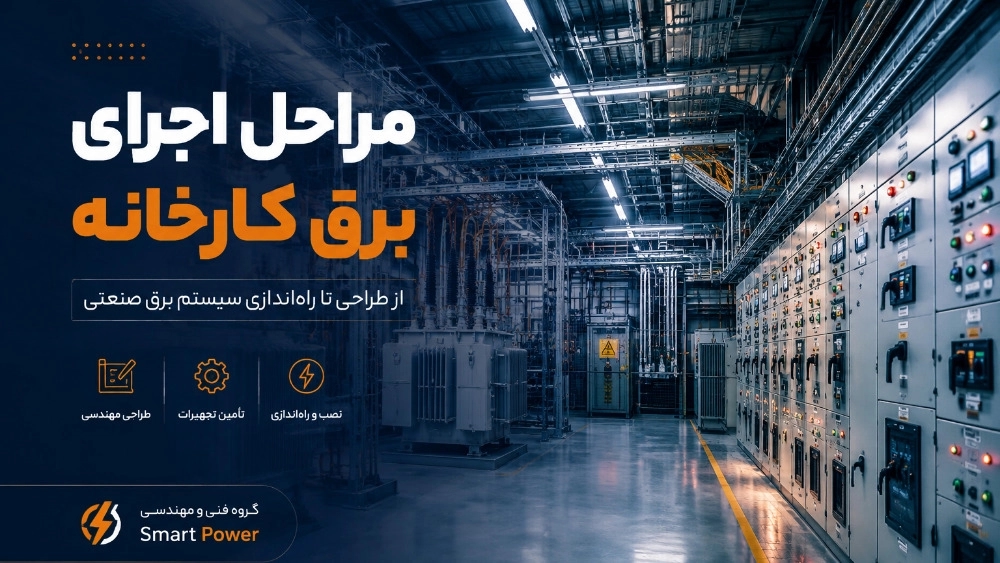
Manufacturing industries and large factories need a stable and engineered infrastructure to maintain the continuity of their activities and prevent heavy damages due to sudden power outages. The implementation of factory electricity is one of the most complex electronic and power engineering projects, the smallest defect in any of its stages can lead to irreparable financial and life accidents. To achieve a stable, safe and optimal system, employers need to cooperate with experienced and expert groups in this field. In the meantime, the smart power technical and engineering group, relying on modern technical knowledge, modern equipment and experienced staff, covers all the stages of this sensitive process from the initial phase of studies to the final installation and operation with the highest national and international standards.
Preliminary studies and estimation of the electric load of the factory
The first and most important step in the way of implementing factory electricity is to conduct detailed studies and calculate the consumption load of the entire industrial unit. At this stage, the engineers of the technical and engineering group of smart power estimate the amount of flow and real power consumption by carefully examining the catalog of machines, production lines, cooling and heating systems, public and private lighting, as well as predicting the future development plans of the factory. The exact determination of the demand or the branching right requested from the Ministry of Energy is done based on these calculations in order to avoid the imposition of additional costs for the purchase of excess demand or fines due to consumption exceeding the permitted limit. Failure to correctly estimate at this stage can lead to a severe voltage drop in the factory's internal network and damage to electric motors and sensitive electronic boards in the future.
Design of industrial electricity system maps and energy distribution
After finalizing the electrical load calculations, the design phase of engineering drawings begins, which forms the core of the industrial power system. These drawings include single-line diagrams of individual electrical panels, cabling routes, equipment placement in the substation, grounding system, and lightning protection system. The technical and engineering group of smart power uses specialized software such as ePLAN and AutoCAD Electrical in the design of these maps to create a perfect coordination between different departments. At this stage, the standardization of cable distances, short-circuit current calculations, selection of suitable cable sizes based on distance and permissible voltage drop, as well as placement of cable trays in risers and transmission channels are planned with high precision so that periodic maintenance and repairs in the future are possible in the simplest possible way.
Construction of passage substation and installation of voltage reducing transformer
Most large industrial factories receive electricity at medium voltage levels due to the high volume of consumption and need to build a dedicated power substation. The implementation of the factory's electricity in this section includes the construction of the technical building of the passage post in accordance with the standards of the electricity distribution company and the installation of medium to low voltage step-down transformers. Choosing a transformer with suitable capacity, installing cooling systems, advanced protection relays such as Buchholts relay and temperature control thermometers are key measures of this stage. The technical and engineering group of smart power, by closely monitoring the installation of transformers and ancillary equipment of the power station, guarantees that the transfer of energy from the national grid to the factory's industrial power system is carried out with the lowest losses and the highest safety factor.
Construction and installation of main and secondary distribution boards of industrial electricity
Electrical boards act as the mastermind of the industrial electrical system and are responsible for controlling, protecting and distributing electric current among different consumers. The construction of these panels includes main distribution panels, capacitor panels for correcting the power factor, motor control panels and intelligent control panels with programmable logic control systems. In the process of making panels by the smart power technical and engineering group, high-quality parts and world-reputable brands are used to have enough resistance against short-circuit currents and sudden overloads. Copper ingots with standard thickness, regular wiring with precise numbering of wires and installation of suitable ventilation systems inside the panels are technical requirements that guarantee the final quality of the work.
Infrastructure and creation of cable and pipeline transmission routes
The transmission of electrical current from distribution boards to machinery and production line equipment requires the creation of a strong and safe physical infrastructure. This section includes installing galvanized metal cable trays at the appropriate height, running cable ladders in vertical sections, steel and PVC piping in wet or vulnerable areas, and digging concrete channels. In the implementation of factory electricity, compliance with the standards of separation of power cables from command and network cables is of vital importance to prevent the impact of noise and electromagnetic waves on the performance of sensors. By using fireproof and shielded cables in sensitive routes, the smart power technical and engineering group ensures the stability of data transmission and electricity flow throughout the production halls.
Cabling and connecting equipment to the industrial power system
Cabling operations include guiding the cables from the trays and inside the pipes to reach the terminal of the consumer devices and equipment. Choosing a cable with the right cross-section to prevent wires from heating up and wasting energy, as well as using standard cable washers and suitable heat presses at the connection points, are very key technical points that, if ignored, can cause fire at the connection points. The specialists of the technical and engineering group of smart power provide safe and stable electrical connections for all devices using advanced hydraulic tools and standard cables with resistant insulation to minimize current fluctuations.
Design and implementation of earthing system and protective bonding
The safety of employees and the protection of expensive electronic equipment of the factory against overvoltages caused by lightning or network errors depends on having an efficient and engineered earthing system. This stage begins with digging earth wells and installing copper plates deep in the ground along with soil resistance reducing materials. The purpose of implementing the earth system is to achieve an electrical resistance below two ohms. In addition to the implementation of specialized earth wells, the smart power technical and engineering group implements a protective bonding system in the entire structure of the factory so that all metal structures, device bodies and tanks are connected to the zero potential of the ground and the risk of electrocution or electric spark is completely eliminated.
Setting up the industrial power system and pre-operational tests
After completing the installation and electrical connections, it is the turn of the most sensitive stage, i.e. start-up and pre-operational tests. In this phase, insulation tests of cables, ground resistance test, polarities check, correct operation of miniature and automatic switches and calibration of protective relays are performed. Experienced engineers of the smart power technical and engineering group ensure the coordinated operation of all parts of the industrial power system by performing cold and hot tests and simulating possible error conditions. The test start-up of electric motors and equipment under controlled load is the last step before the official delivery of the project to the client, which is done with full compliance with safety checklists.
Optimization and intelligentization of energy consumption management in factories
Today, with the increase in the costs of energy carriers, the intelligent management of electricity consumption in industries has become a main priority. The use of automatic capacitor banks to eliminate reactive power and avoid electricity bill fines, the use of remote control drives to reduce the starting current of motors, and the use of online electric current monitoring systems are some of the effective solutions in this field. The smart power technical and engineering group helps factories to significantly reduce their electricity consumption costs and increase the useful life of their electrical equipment by designing and implementing new energy intelligentization packages.
Summary
The stability and safety of the industrial power system after start-up requires continuous monitoring and preventive maintenance. The occurrence of any loose connection or abnormal temperature increase in the equipment can lead to the stoppage of the production line and heavy financial losses. By providing round-the-clock support services and periodic inspections with advanced equipment such as thermovision cameras to identify hot spots before an accident, the smart power technical and engineering group brings peace of mind to industrial owners so that they can focus on increasing production productivity without technical concerns.